 EN


By Andy Huang, Engineer, Guangzhou Dingchengzun Building Materials
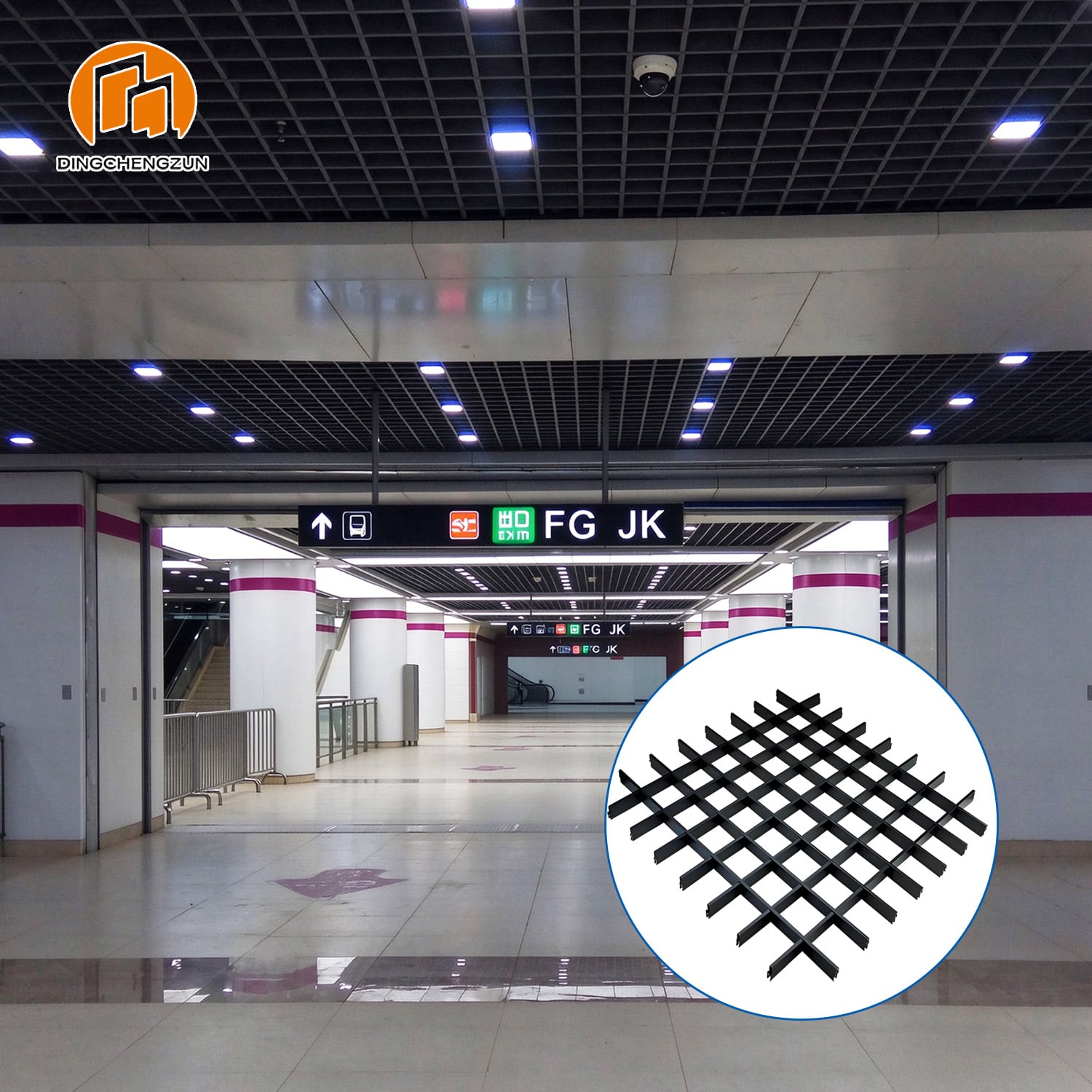
In 2026, a standard aluminum open cell ceiling costs about US$7.8–9.1 per m² FOB Guangzhou for the most common spec: 100 × 100 mm cells, 40 mm high, 0.4 mm thick, white powder coat. The biggest price driver is cell size. A 50 × 50 mm grid uses four times as much aluminum as a 200 × 200 mm grid, so it costs about twice as much per m². Prices below are for panels with export packing, orders of about 1,000 m². Main runners and hangers are quoted separately. Because aluminum prices move daily, our quotations are valid for 15 days.
Have a drawing? Send it on WhatsApp and our engineers will price your exact spec within 24 hours. Chat on WhatsApp →
Open cell ceiling price by cell size (2026)
Basis: 40 mm blade height, 10 mm blade width, 0.4 mm thickness, white powder coating, panels only, FOB Guangzhou.
| Cell size (mm) | Aluminum used (kg/m²) | Price, FOB Guangzhou (US$/m²) | Typical use |
|---|---|---|---|
| 50 × 50 | 3.90 | 14.0–16.0 | Feature ceilings, supermarkets, small lobbies |
| 75 × 75 | 2.60 | 10.0–11.0 | Restaurants, retail |
| 100 × 100 | 1.95 | 7.8–9.1 | Offices, malls, corridors (most popular) |
| 150 × 150 | 1.30 | 7.0–8.3 | Malls, metro stations, large halls |
| 200 × 200 | 0.98 | 6.5–7.8 | Parking garages, warehouses, budget projects |
Why cell size drives the price
An open cell ceiling is a grid of folded blades running in two directions. The smaller the cell, the more blade length you need in every square meter:
Blade length per m² = 2 × 1000 ÷ cell size (mm)
Aluminum per m² (kg) = blade length (m) × (2 × H + W) (mm) ÷ 1000 × t (mm) × 2.71
At the LME aluminum price of about US$3.11/kg (October 30, 2026), the metal alone costs:
| Cell size (mm) | Blade length per m² | Aluminum (kg/m²) | Metal value (US$/m²) |
|---|---|---|---|
| 50 × 50 | 40.0 m | 3.90 | 12.1 |
| 75 × 75 | 26.7 m | 2.60 | 8.1 |
| 100 × 100 | 20.0 m | 1.95 | 6.1 |
| 150 × 150 | 13.3 m | 1.30 | 4.0 |
| 200 × 200 | 10.0 m | 0.98 | 3.0 |
Spec: H 40 mm, W 10 mm, t 0.4 mm. LME is the price of primary ingot. Coated coil costs more, so read these figures as the floor of any honest quote.
Want this table for your own spec? Tell us the cell size, height and thickness and we will send a priced quotation sheet. Request a quote →
Other factors that change the price
- Blade height: going from 40 mm to 50 mm adds about 25% more aluminum, 60 mm about 50%, and 80 mm about 100%.
- Thickness: 0.5 mm uses 25% more metal than 0.4 mm, and 0.6 mm about 50% more. Below 0.4 mm, blades bend easily during installation.
- Finish: wood-grain transfer and PVDF cost more than white powder coating. Black costs a little more; special custom colors need a color-matching sample and cost more again.
- Profile: double-layer grids use roughly twice the material. Serrated (toothed or grooved) blades need extra stamping and tooling.
- Quantity: orders below the MOQ cost more per m² because the set-up cost is shared over fewer meters.
Standard specifications
| Parameter | Range | Most common |
|---|---|---|
| Cell size | 50 × 50 to 200 × 200 mm | 75, 100, 150 mm |
| Blade width | 10 mm, 15 mm (20 mm custom) | 10 mm for small cells; 15 mm for large cells and long spans |
| Blade height | 30–100 mm standard; 20–300 mm custom | 30, 40, 50, 60, 80 mm (10 mm blades: 30–50 mm; 15 mm blades: 50–80 mm) |
| Thickness | 0.3–1.0 mm | 0.4, 0.5, 0.6 mm |
| Blade length | 1,800 / 1,950 / 2,000 mm | Main and cross blades lock together on site |
There is no fixed 600 × 600 module. Main and cross blades clip together into a continuous grid, so the ceiling fits any room size. As a rule, choose 0.3–0.4 mm for small, low interiors, 0.5–0.6 mm for projects of 1,000 m² or more, and 0.8–1.0 mm for outdoor or long-span areas.
Add-on prices
| Option | Extra cost (US$/m²) |
|---|---|
| 0.5 mm instead of 0.4 mm | +1.8–2.3 |
| 0.6 mm instead of 0.4 mm | +3.5–4.5 |
| 50 mm blade height | +0.6–0.9 |
| 60 mm blade height | +1.1–1.6 |
| 80 mm blade height | +2.0–2.8 |
| Black powder coat | +0.3–0.6 |
| Special custom color (color-matched sample) | +0.7–1.4 |
| Wood-grain transfer | +1.0–1.7 |
| PVDF coating | +2.1–3.5 |
| Serrated (toothed/grooved) blades | +1.4–2.8 |
| Double-layer grid | +8.5–14.0 |
Thickness surcharges are for a 100 × 100 mm grid. Smaller cells use more blade per m², so their surcharge is higher.
Suspension and accessories
Open cell ceilings hang from a carrier system on threaded rods. Our panel prices do not include it, so here is what a full set costs on a typical 1,000 m² order:
| Accessory | Specification | Quantity per m² | Cost (US$/m²) |
|---|---|---|---|
| Main runner | 38-type light-steel runner, 3 m | 0.8–1.0 m | 0.40–0.70 |
| Grid carrier | Aluminum carrier for open cell blades, 3 m | 1.0–1.2 m | 1.04–1.25 |
| Threaded rod | M6 fully threaded, 1 m | 1.0–1.2 pcs | 0.11–0.20 |
| Main runner hanger | Galvanized, painted | 1.0–1.2 pcs | 0.28–0.34 |
| Grid clips | Connect blades to the carrier | 4–6 pcs | 0.16–0.42 |
| Edge trim | 20 mm aluminum angle, white, 3 m | 0.3–0.5 m | 0.10–0.19 |
| Total | 2.1–3.1 |
Small cells such as 50 × 50 mm need more clips and carrier per m², so accessories cost about 10–15% more. Ceilings above 3.5 m need longer rods, which adds a little more. Always check whether a quote includes accessories: a low panel price can hide expensive ones.
Freight and landed cost
Open cell ceilings are light but bulky, so the container fills up by volume long before it reaches its weight limit. One export carton (1,200 × 600 × 120 mm, about 0.086 m³) holds about 7.2 m² of 100 × 100 grid and weighs about 15 kg. Ten cartons make one pallet of about 72 m².
| Container | Usable volume | Open cell ceiling per container |
|---|---|---|
| 20GP | 26–28 m³ | about 2,100–2,400 m² |
| 40HQ | 65–68 m³ | about 5,400–5,700 m² |
For 50 × 50 mm cells, a carton holds 15–20% fewer m²; for 200 × 200 mm, about 10% more. Shipping accessories in the same container reduces the ceiling area by 10–15%. Ask for a CIF price to your port if you want to compare landed cost. See how we pack ceilings for export in our packaging and shipping guide.
Project example: 3,000 m² supermarket ceiling
For a 3,000 m² supermarket, we supplied 50 × 50 mm open cell grid in 0.5 mm aluminum. Small cells give a dense, uniform look over long sales aisles while still letting lights, sprinklers and air diffusers work through the ceiling. The 0.5 mm gauge keeps the blades straight over a large area.
How to spot a quote that is too cheap
- Compare it with the metal value. If a quote for 100 × 100 grid at 0.4 mm is close to US$6/m², the supplier is probably using thinner metal than stated.
- Ask for base-metal thickness. "0.4 mm" measured over the coating may be 0.3 mm of aluminum.
- Check what is included. Panels only, or panels plus accessories?
- Ask for a sample. Weigh one cell module and compare it with the formula above.
Not sure who you are buying from? Read Factory vs Trading Company: How to Choose an Aluminum Ceiling Supplier.
How to get an accurate quote
Send us these six points:
- Cell size (e.g. 100 × 100 mm)
- Blade height and width
- Base-metal thickness
- Color or finish
- Total area in m² and ceiling height
- Delivery port
Get a quotation in 24 hours. MOQ is 300 m². Lead time is about 10 days for standard colors and 20 days for custom colors. Quotations are valid for 15 days. Get a Quote →
Browse our aluminum grid ceiling products, or compare all systems in Aluminum Ceiling Price per m²: What Affects the Cost.
FAQ
How much does an open cell ceiling cost per m²?
For 100 × 100 mm cells, 40 mm high and 0.4 mm thick in white, expect about US$7.8–9.1 per m² FOB Guangzhou in 2026. Smaller cells and thicker blades cost more.
Why does a 50 × 50 grid cost more than 150 × 150?
It needs three times as much blade length per m² (40 m vs 13.3 m), so it uses three times as much aluminum.
What thickness should I choose?
0.4 mm suits most interiors. Choose 0.5 mm or more for high-traffic areas, long spans or tall blades.
Does the price include the suspension system?
No. Our panel prices include export packing but not main runners or hangers. A full accessory set adds about US$2.1–3.1 per m².
What are the MOQ and lead time?
The MOQ is 300 m². Lead time is about 10 days after order confirmation for standard colors and about 20 days for custom colors.
Table of Contents
- Open cell ceiling price by cell size (2026)
- Why cell size drives the price
- Other factors that change the price
- Standard specifications
- Add-on prices
- Suspension and accessories
- Freight and landed cost
- Project example: 3,000 m² supermarket ceiling
- How to spot a quote that is too cheap
- How to get an accurate quote
- FAQ