 EN


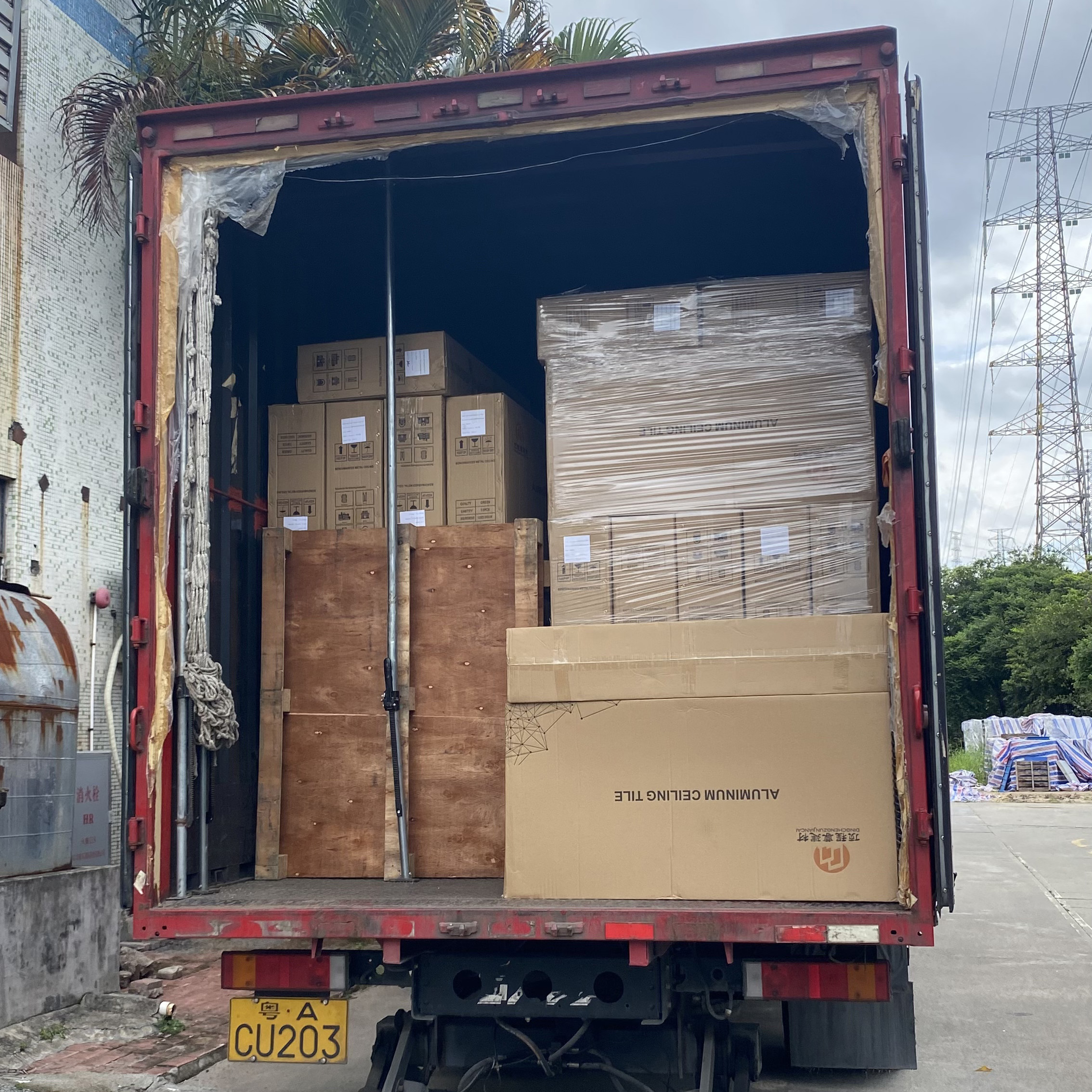
An aluminum ceiling can leave the factory perfect and arrive scratched, dented or bent. Coated surfaces mark easily, folded edges dent under weight, and long baffles bend if they are not supported. On a light-colored ceiling under bright lighting, every one of those marks shows.
This guide explains how we pack each ceiling system, how containers are loaded, which shipping terms and documents you will deal with, and what to check when the goods arrive.
How each ceiling system is packed
System |
Surface protection |
Outer packing |
Typical unit |
|---|---|---|---|
Clip-in / lay-in tiles (600×600) |
PE protective film on the face |
Export carton, palletized and strapped |
18–30 tiles per carton, most often 20 |
Strip / linear ceiling |
PE protective film, plastic corner protectors on both ends |
Bundles |
10–20 strips per bundle |
Baffle / U-profile |
PE protective film, plastic corner protectors on both ends |
Bundles; individual wrapping on request |
10–20 baffles per bundle |
Solid aluminum veneer |
Protective film on the finished face; EPE foam sheets between panels |
ISPM 15 fumigated solid-wood pallet; closed wooden crate for special shapes, large or high-value panels |
Per project |
Mirror-finish and anodized products, whose surfaces show the slightest mark, can be individually wrapped on request. Suspension parts (carriers, hangers, tees and trims) are packed separately and labeled to match the panels they belong to.
Protective film, carton marks and zone labels
Protective film. Every panel leaves the factory covered by a clear PE static-cling film over the whole decorative face, which can be printed with your brand. Remove it within 7 days of project completion, and earlier in hot, sunny conditions, where the adhesive can age and leave residue or ink marks. Peel at about 45° with a steady pull to avoid leaving adhesive behind.
Carton marks. Every carton shows the project name, product code, size, color, quantity and carton number, so the site team can check deliveries against the packing list without opening boxes.
Zone labels. By default, labels show specification, quantity and batch. For large projects, we can add custom labels by floor or zone number, matching your ceiling drawings, so the site team can send each carton straight to its area. Ask for this when you place the order.
Container loading
Aluminum ceilings are light, so a container fills up by volume long before it reaches its weight limit. What decides how many square meters fit is the shape of the product, not its weight.
Container |
Approx. inner size (L × W × H) |
Approx. volume |
Best for |
|---|---|---|---|
20' GP |
5.9 × 2.35 × 2.39 m |
33 m³ |
Smaller orders, tiles and strips |
40' GP |
12.0 × 2.35 × 2.39 m |
67 m³ |
Long strips and baffles up to about 6 m |
40' HQ |
12.0 × 2.35 × 2.69 m |
76 m³ |
Bulky products such as baffles and open cell |
How many square meters per container? From our loading records:
- 600×600 clip-in tiles, 0.5–0.6 mm: 1,500–1,900 m² per 20' GP, about 340 cartons.
- Strip ceiling, 300×1200 mm: 4,000–5,200 m² per 40' HQ.
- U-baffles up to 3 m long: 3,500–4,500 m² per 40' HQ, depending on baffle height and thickness.
Flat tiles and strips pack densely. Baffles and open cell take far more space per square meter of finished ceiling, so freight is a bigger share of their landed cost.
We photograph every container at each key stage: the empty container check, a close-up of the container and seal numbers, loading in progress, the fully loaded and braced container, and the moment of sealing. You receive the full set, which serves as clear evidence if any transit damage needs to be claimed.
Shipping routes and trade terms
Sea freight is the standard route for most projects. We usually ship from Foshan and Huangpu ports, with containers trucked from our factory for loading. Full container loads (FCL) are best for project orders. Less-than-container loads (LCL) suit small orders but are handled more often, so packaging matters even more.
Rail and road suit landlocked destinations in Central Asia. For Kazakhstan, Uzbekistan and neighbors we prefer rail via the Alashankou or Khorgos border crossings, about 15–20 days door to door and more predictable than road. Our Almaty Airport project was delivered overland to Kazakhstan.
Term |
We deliver to |
You arrange |
|---|---|---|
EXW |
Our factory gate |
All transport, export clearance and import |
FOB |
On board the vessel at the Chinese port |
Ocean freight, insurance, import clearance, delivery |
CIF |
Your destination port, freight and insurance paid |
Import clearance, duties, delivery to site |
DDP |
Your site, duties paid |
Unloading and storage |
FOB suits buyers with their own freight forwarder. CIF is simpler for first-time importers. DDP is the easiest but the least transparent on cost, and is not available to every country. We offer EXW, FOB and CIF as standard. DDP covers most major markets, including Southeast Asia, the Middle East, the EU and Australia. For countries with high duties or unusual clearance rules, we confirm a logistics plan case by case.
Export documents
We prepare the standard export set with every shipment. Check with your customs broker early, because some countries need extra papers.
- Commercial invoice: product description, HS code, quantity, value and trade term.
- Packing list: carton numbers, contents, net and gross weights, and volume.
- Bill of lading (sea) or rail and road waybill.
- Certificate of origin: a general certificate, or a preferential one where a trade agreement applies (for example Form E for ASEAN countries), which can lower import duty.
- Product documents: fire test report and material or coating test reports, often requested by customs or the project consultant.
- Wooden packaging: solid-wood crates and pallets must meet ISPM 15 (heat-treated and stamped). Plywood and engineered wood are exempt.
On request we also supply SGS or BV third-party inspection certificates, SASO certification for Saudi Arabia, SONCAP for Nigeria, CE or UKCA conformity documents, and RCEP preferential certificates of origin.
When the goods arrive
- Photograph the container before opening, including the seal number, then photograph each stage of unloading.
- Count cartons against the packing list before the truck or container leaves.
- Unload by hand or with care. Never drag cartons or drop them on edges. Carry long baffle bundles with support at several points.
- Store indoors, flat and dry, on pallets off the floor, away from direct sun and wet trades such as plastering. Do not stack heavier goods on top.
- Open a sample of cartons from each batch and check color, dimensions and finish before installation starts.
- Report damage promptly with photos and carton numbers. Inspect and submit any written claim for damage or wrong items within 7 working days of arrival, with site photos. Once responsibility is agreed, we produce and ship replacements within 7–15 days. Small replacements can travel with your next shipment, and extra freight is paid by whichever side was responsible.
FAQ
How long does shipping take? It depends on the route. Typical transit times are about 7–12 days by sea to South Asia (India, Pakistan), 14–20 days to the Middle East (Dubai, Saudi Arabia), 20–30 days to East Africa, 30–40 days to West Africa, and 15–20 days by rail to Central Asia.
Can you ship ceilings together with other building materials? Yes. We can consolidate suspension systems and accessories in the same container, and coordinate with your forwarder if other suppliers' goods are loaded with ours.
Is cargo insurance included? Under CIF and DDP, we arrange insurance to the destination. Under FOB and EXW, insurance is your responsibility, and we strongly recommend it.
Can I see my goods before they ship? Yes. We send production and loading photos, and you or a third-party inspector are welcome to check goods at our factory before loading.