 EN


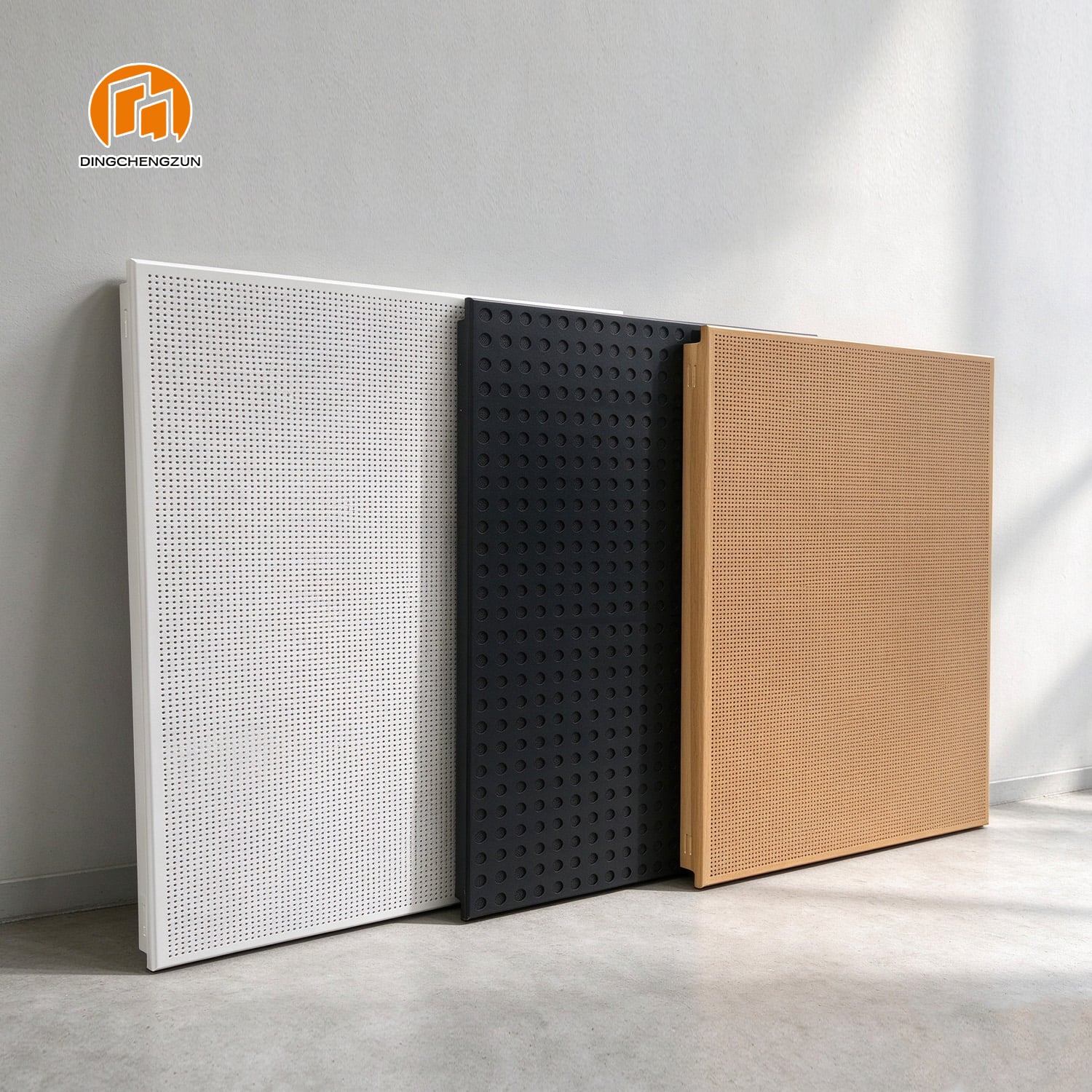
Aluminum ceilings come in four main types: baffle, strip, open cell (grid) and clip-in tile. All four resist moisture well, so the real choice comes down to look, access to the services above, acoustics, installation speed and price. In 2026, our FOB Guangzhou prices run from about US$7 to US$21 per m², depending on type and thickness. This guide compares the four side by side, using our own price lists and projects.
Not sure which type fits your project? Send your drawing on WhatsApp and our engineers will recommend one within 24 hours. Chat on WhatsApp →
The four types at a glance
Feature |
Baffle |
Strip |
Open cell |
Clip-in tile |
|---|---|---|---|---|
Look |
Deep vertical blades, strong 3D lines |
Flat linear lines |
Open grid of small cells |
Flat, continuous panels |
Moisture resistance |
Good |
Good |
Good |
Good |
Access to services above |
Medium |
Good |
Good |
Good |
Sound absorption |
Fair (perforated: medium) |
Fair |
Fair |
Medium (perforated: good) |
Installation speed |
Medium |
Good |
Good |
Good |
What each type costs (2026, FOB Guangzhou)
Basis: white powder coat, standard colors, MOQ 300 m². Suspension systems are quoted separately for all four types.
Type |
Typical specification |
Price (US$/m²) |
Aluminum (kg/m²) |
|---|---|---|---|
Baffle |
50 × 100 mm, 0.6 mm, 300 mm centers |
7–11 |
1.46 |
Baffle |
30 × 150 mm, 1.4 mm, 300 mm centers |
17–21 |
4.43 |
Strip |
84R, 0.5 mm |
9.6–11.0 |
2.36 |
Open cell |
100 × 100 mm cells, 40 mm high, 0.4 mm |
7.8–9.1 |
1.95 |
Clip-in tile |
600 × 600 mm, 0.6 mm |
8.3 |
1.90 |
Price follows the aluminum in each square meter. A tall, thick baffle uses more than twice as much metal as a strip or a tile, which is why it costs more.
Baffle ceiling
Vertical aluminum blades hang from a carrier at 50–400 mm centers. Baffles give the strongest visual depth of the four, and they partly hide the services above while letting light and air through. They suit airports, malls, lobbies and high ceilings.
The trade-offs: reaching the services above means removing baffles section by section, installation needs careful carrier alignment, and tall, thick blades cost more.
Example: for 12,643 m² at Almaty International Airport we supplied 30 × 150 mm baffles in 1.4 mm aluminum, finished in RAL 9016. Read the Almaty airport baffle ceiling case study, our U-baffle ceiling procurement guide, or browse our aluminum baffle ceiling products.
Strip ceiling
Folded strips, 84 to 300 mm wide, clip onto a toothed carrier. Strips give a clean linear look with the least installation effort, and a single strip can be unclipped by hand to reach the services above. Open-joint 84R and 85C strips leave a fine shadow line; the 100 closed-joint strip fits edge to edge for kitchens and bathrooms; the 300 wind-resistant strip has a 30 mm high edge for outdoor soffits and canopies.
The trade-off: plain strips absorb little sound unless they are perforated.
Example: we supplied 8,500 m² in total of 300 wind-resistant strips, 0.8 mm, to gas stations in the Pearl River Delta, and 12,000 m² in total of 150C strips, 0.6 mm, to a large shopping mall in Baiyun New Town, Guangzhou. Browse our aluminum strip ceiling products.
Open cell (grid) ceiling
A grid of crossing blades, from 50 × 50 to 200 × 200 mm cells. Lights, sprinklers and ducts can sit above or show through the grid, and the modular cells go up quickly. Open cell suits retail, supermarkets and spaces where the services should stay visible or within reach.
The trade-off: an open grid absorbs very little sound on its own, because sound passes through it into the ceiling void.
Example: for a 3,000 m² supermarket we supplied 50 × 50 mm cells in 0.5 mm aluminum. Browse our aluminum grid ceiling products.
Clip-in tile ceiling
Square tiles, usually 600 × 600 mm (300 × 300, 300 × 600 and 600 × 1200 mm also available), snap onto a concealed carrier. A lay-in version rests on an exposed T-bar. Tiles give a flat, continuous surface, and single tiles can be removed without tools. With perforation and acoustic fleece, tiles are the best of the four for sound absorption, so they suit offices, schools and hospitals.
The trade-off: the flat look has less depth than baffles or strips.
Example: for a new outpatient building at a top-tier tertiary hospital in Foshan, we supplied 12,800 m² of 600 × 600 mm, 0.7 mm white micro-perforated acoustic tiles with an antibacterial coating, completed in 2025.
Which type should you choose?
- High ceilings and a dramatic look in airports, malls and lobbies: baffle.
- Long corridors, wet areas and fast installation: strip. Use the 100 closed-joint strip in kitchens and bathrooms, and the 300 wind-resistant strip outdoors.
- Retail and supermarkets where the services stay visible or within reach: open cell.
- Offices, schools and hospitals that need good acoustics and easy access: clip-in tile with perforation and acoustic fleece.
How to compare quotes across types
Always compare price per m² of finished ceiling, on the same finish and thickness basis. For baffles, ask for the center spacing: the same 30 × 150 mm baffle costs about three times as much per m² at 100 mm centers as at 300 mm. For every type, ask whether the price includes the suspension system and export packing. Not sure who you are buying from? Read Factory vs Trading Company: How to Choose an Aluminum Ceiling Supplier.
Packing and container loading
A 40HQ container holds about 2,800–3,200 m² of strips, 5,400–5,700 m² of open cell and about 5,200 m² of 0.6 mm clip-in tiles. Baffle loading depends on the blade size and length, so we calculate it for each project. See how we pack ceilings for export in our packaging and shipping guide.
Get a quotation in 24 hours. MOQ is 300 m² and lead time is about 10 days for standard white powder coat. Quotations are valid for 15 days. Get a Quote →
Compare prices across all systems in Aluminum Ceiling Price per m²: What Affects the Cost.
FAQ
What are the main types of aluminum ceilings?
The four main types are baffle, strip, open cell (grid) and clip-in tile. Each comes in several sizes and thicknesses.
Which aluminum ceiling is the cheapest?
Price follows the aluminum used per m². At the specifications above, open cell, clip-in tiles and light baffles are close at about US$7–11 per m². Wide strips and large cells cost less because they use less metal, and tall, thick baffles cost the most.
Which type is best for humid areas?
All four are aluminum and resist moisture well. For kitchens and bathrooms, the 100 closed-joint strip is the usual choice because the strips fit edge to edge.
Which type is best for sound absorption?
Clip-in tiles with perforation and acoustic fleece. Baffles can reach a medium level when perforated, while plain strips and open cell absorb little.
Does the price include the suspension system?
No. Suspension systems are quoted separately for all four types. Tell us your ceiling height and layout and we will list the exact parts.