 EN


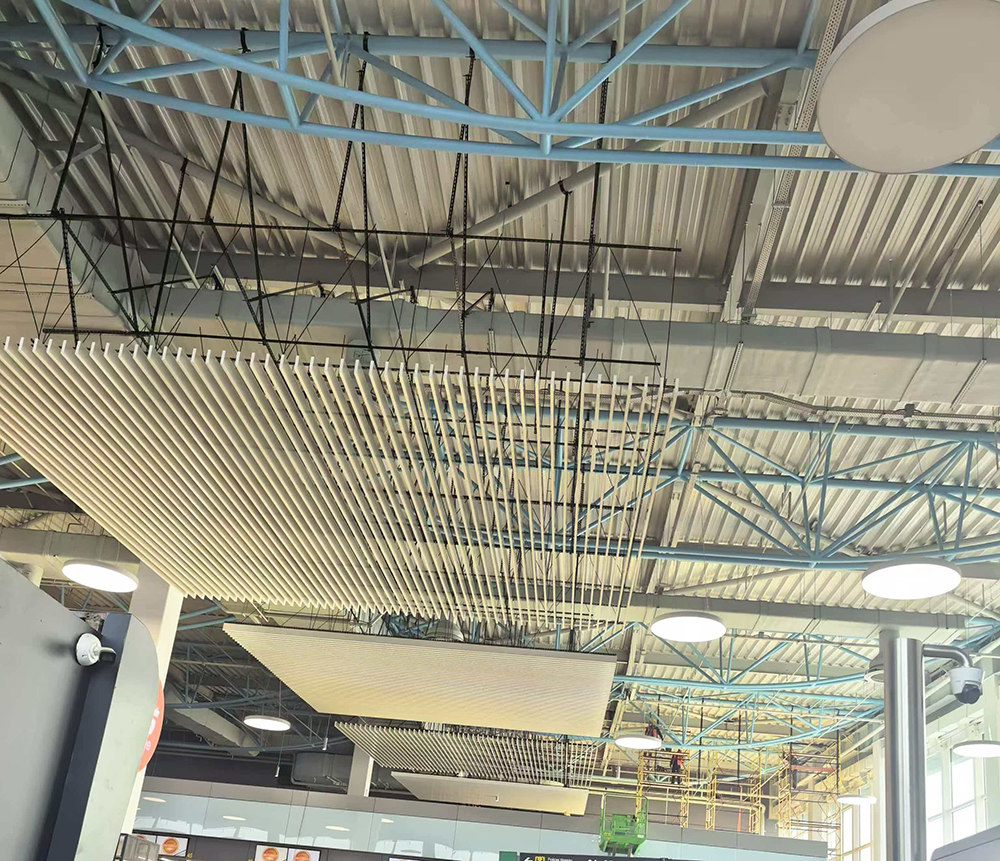
In 2026, Dingchengzun supplied and installed 12,643 m² of aluminum baffle ceiling across multiple zones of the terminal at Almaty International Airport, Kazakhstan's busiest air hub. It is one of our largest single-site overseas projects to date.
Airport ceilings are judged on three things: a uniform look across huge open spans, clean integration with lighting and building services, and fire safety for a high-occupancy public building. This article walks through how we handled each one, from production line to terminal ceiling. For the project photos, see the Almaty Airport project page.
Project at a glance
Item |
Details |
|---|---|
Project |
Almaty International Airport terminal interior fit-out |
Location |
Almaty, Kazakhstan |
Scope |
Supply and installation of aluminum baffle ceiling |
Total area |
12,643 m² |
Areas covered |
Multiple terminal zones [TO CONFIRM: e.g. check-in hall, departure lounge, corridors] |
Ceiling system |
Aluminum baffle (linear) ceiling [TO CONFIRM: U-shaped / rectangular / square tube] |
Finish |
White powder coating |
Completed |
2026 [TO CONFIRM: month] |
Delivery |
Overland transport from Guangzhou [TO CONFIRM: transit time] |
Four challenges and how we solved them
1. One consistent look across 12,643 m²
In an open terminal, the eye travels along hundreds of meters of baffles. A slight shift in white tone, a bowed profile or uneven spacing shows up immediately under bright, even lighting.
On a ceiling this size, consistency is decided in the factory, not on site. We ran the order on the same production line with controlled coating parameters, and checked color and straightness batch by batch against an approved master sample. [TO CONFIRM: color-difference tolerance used, e.g. ΔE ≤ 1.0]
2. Integrating lighting and building services
A terminal ceiling carries light fittings, air diffusers, sprinklers, speakers, CCTV and wayfinding signs. In an open baffle ceiling, all of these sit in plain view between the baffles.
We worked from the project's coordinated ceiling drawings and set baffle layout and spacing so services fall between baffles rather than cutting through them. [TO CONFIRM: number of drawing revisions, and whether a site mock-up was approved before production]
3. Fire safety for a high-occupancy building
Airport interiors must use non-combustible materials. Aluminum baffles do not burn or drip, and the thin powder-coat layer adds very little to the fire load. [TO CONFIRM: fire classification and test report supplied, e.g. EN 13501-1 A2-s1,d0 or GOST equivalent]
4. Matching batches across phased construction
Terminals are fitted out zone by zone, so panels for one area may be made weeks after those for another. Every later batch had to match the first in color, gloss and dimensions.
Our production management kept specification and appearance identical across deliveries. [TO CONFIRM: how batches were matched, e.g. one powder supplier and lot record for the whole job, and reference samples kept from the first delivery]
Product specification
Parameter |
Almaty Airport specification |
Options available for other projects |
|---|---|---|
Profile |
[TO CONFIRM] |
U-shaped, rectangular, square tube |
Baffle size (W × H) |
[TO CONFIRM: e.g. 50 × 100 mm] |
Custom to drawings |
Length |
[TO CONFIRM] |
Custom, typically up to 6 m |
Thickness and alloy |
[TO CONFIRM: e.g. 0.8 mm, 3003] |
0.6–1.2 mm |
Spacing (centers) |
[TO CONFIRM: e.g. 150 mm] |
Custom to design |
Finish |
White powder coating |
Powder coat, PVDF, anodized, wood grain |
Suspension |
[TO CONFIRM: carrier type and hanger spacing] |
Matched to ceiling height and services |
See the full range on our baffle ceiling page.
Production, packaging and transport
Production and inspection. Baffles were formed on our CNC lines in Guangzhou, then checked for dimensions, straightness, coating thickness and color before packing. [TO CONFIRM: production time for 12,643 m² and the inspection items recorded]
Packaging. A white powder-coated finish shows every scuff and fingerprint under terminal lighting. So every baffle was individually sealed in protective plastic film before cartoning, keeping the surface clean through loading, transport and site storage.
Transport. The baffles traveled a long overland route from China to Almaty. [TO CONFIRM: route, e.g. truck via the Khorgos border crossing, and door-to-door transit time] [TO CONFIRM: how long baffles were braced against bending, and whether pallets were labeled by installation zone]
Installation. [TO CONFIRM: whether our engineers supervised on site, provided remote video guidance, or supplied installation drawings to a local contractor]
Lessons for anyone specifying an airport baffle ceiling
- Approve a master color sample before production. On large white or light ceilings, agree a physical reference and a color-difference tolerance in the contract.
- Lock the services layout first. Baffle spacing should be set after lighting, diffusers and sprinklers are coordinated, not before.
- Ask for the fire test report, not just a claim. Request the classification document for the exact finish you are buying.
- Plan batches for phased handover. Tell the supplier the zone sequence so production and delivery follow the site, and every batch is checked against the first.
- Specify protective packaging for light finishes. Individual film wrapping costs little compared with replacing scuffed baffles on site.
- Price the complete system. Compare quotes including carriers, hangers and trims. Our guide to aluminum ceiling price per m² explains what drives the cost.
FAQ
Why choose a baffle ceiling for an airport terminal? Baffles keep the ceiling open, so services stay accessible and the space feels lighter and taller. They also give strong linear direction, which helps guide passengers through large halls.
Can baffle ceilings improve acoustics in a terminal? Yes. Baffles break up hard reflective surfaces, and perforated baffles with acoustic infill absorb more sound for announcement clarity.
Can you deliver to Central Asia and other overseas sites? Yes. Almaty shows our overland supply to Central Asia, and we also deliver by sea to projects in Africa, Southeast Asia and beyond.