 EN
EN


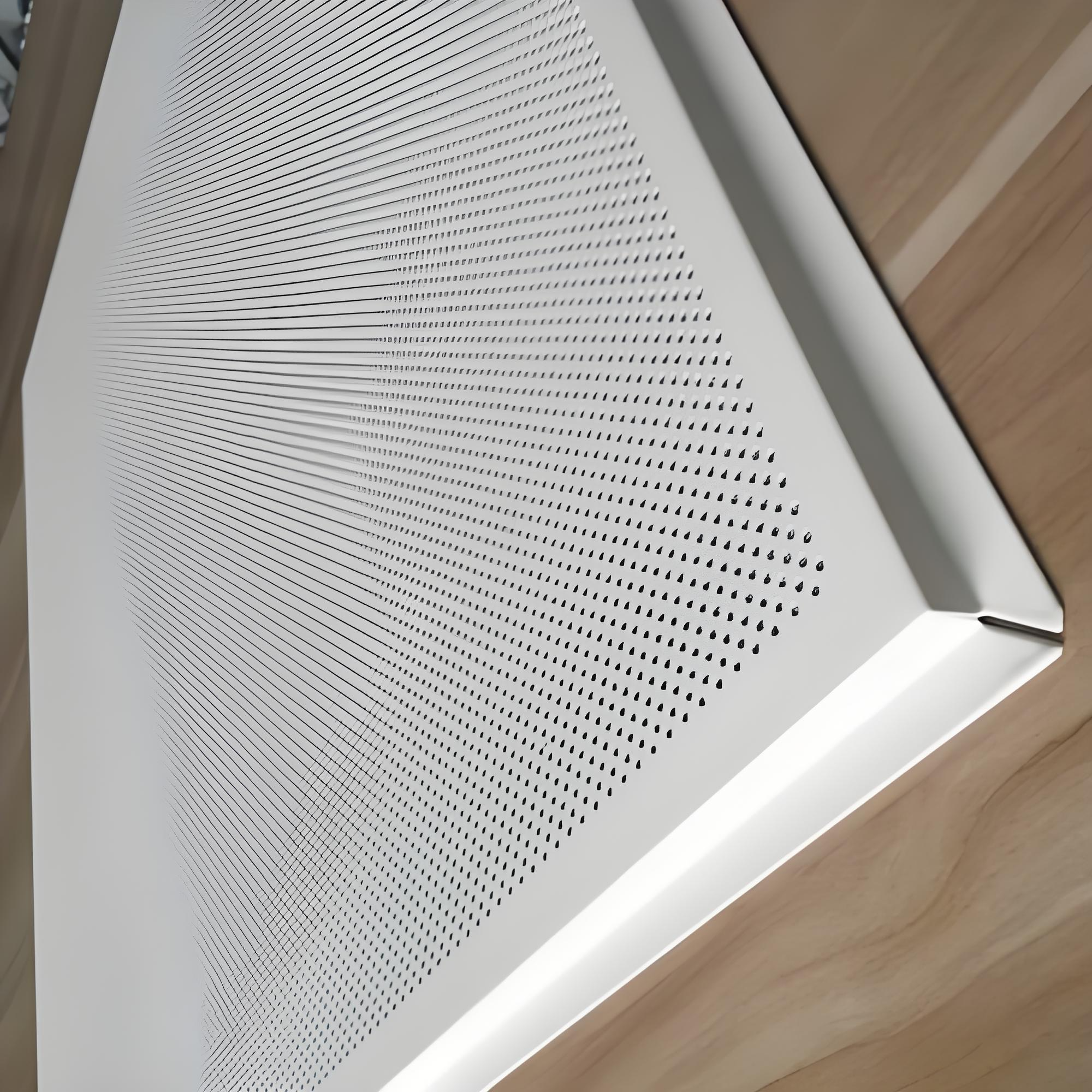
Noise complaints are one of the most common — and most underestimated — problems in commercial interiors. Open-plan offices lose productivity to overheard conversations and keyboard clatter. Hospitals need to keep alarm sounds, footsteps, and equipment noise from carrying between wards. Classrooms depend on clear speech intelligibility for learning outcomes. In every one of these environments, the ceiling is doing more work than most people realize: it's often the single largest continuous surface in the room, which makes it one of the most effective places to control how sound behaves.
This is where the choice between perforated and plain (non-perforated) aluminum lay-in ceiling tiles becomes a real engineering decision, not just an aesthetic one. Both panel types share the same base material and grid-mounted installation method, but they perform very differently once sound waves hit them. This guide compares the two directly — acoustic performance, typical NRC ratings, and which one fits which type of project — so you can specify the right panel the first time.
What Are Aluminum Lay-in Ceiling Tiles?
Aluminum lay-in ceiling tiles are modular ceiling panels designed to drop into a suspended T-grid system, typically in standard sizes such as 600×600 mm or 600×1200 mm. The grid is suspended from the structural slab above, creating a plenum space that conceals wiring, ductwork, and piping while giving maintenance teams easy access — any tile can be lifted out individually without disturbing the surrounding ceiling.
This installation method is one of the reasons lay-in systems remain the default choice for commercial fit-outs: they combine fast installation with long-term serviceability. Our 600×600 Aluminum Lay-in Ceiling Panel is a common baseline configuration used across office and retail projects, and it's available in both perforated and plain finishes — which brings us to the core comparison of this article.
Perforated Aluminum Ceiling Panels: How They Work
Perforated panels are exactly what the name suggests — the aluminum sheet is punched with a regular pattern of small holes before finishing. On their own, these holes don't absorb much sound; what actually does the acoustic work is the fleece backing bonded to the reverse side of the panel, combined with an air gap in the plenum above.
Perforation Pattern & Open Area Ratio
The percentage of the panel surface taken up by holes — the "open area ratio" — directly affects how much sound energy can pass through to the absorptive backing. Most commercial perforated ceiling panels fall in the 15%–25% open area range. A higher open area generally improves mid-to-high frequency absorption but can slightly reduce the panel's visual solidity and, in some cases, its rigidity, so the ratio is usually chosen as a balance between acoustic target and structural/visual requirements.
Role of Acoustic Fleece/Backing Material
The backing material — typically a non-woven acoustic fleece or mineral wool pad — is what actually converts sound energy into heat through friction as air moves through it. Without this backing, a perforated panel behaves almost like a plain one acoustically. This is worth flagging because backing quality varies significantly between suppliers, and it's the single biggest factor separating a panel that measurably reduces noise from one that only looks like it should.
Typical NRC Rating Range for Perforated Panels
Noise Reduction Coefficient (NRC) is the standard metric for how much sound a material absorbs, on a scale from 0 (fully reflective) to 1 (fully absorptive). Perforated aluminum ceiling panels with proper acoustic backing typically achieve an NRC of 0.55–0.85, depending on perforation pattern, open area ratio, backing thickness, and the depth of the plenum air gap above the panel. For reference, a plain metal panel with no backing typically sits below NRC 0.10.
Plain (Non-Perforated) Aluminum Ceiling Panels: Characteristics
Plain panels are solid aluminum sheets with no perforation and, in most cases, no acoustic backing. Acoustically, they function as reflective surfaces — sound waves bounce off rather than being absorbed.
Sound Reflection vs Absorption Trade-off
This reflectivity isn't automatically a downside. In corridors, stairwells, and back-of-house areas, a hard reflective ceiling is often preferred because it's easier to clean, more resistant to moisture and impact, and doesn't require the extra manufacturing step of bonding an acoustic backing. The trade-off only becomes a problem in rooms where speech clarity or noise buildup is a functional concern — a plain ceiling in an open-plan office will let conversational noise carry much further than a perforated one.
Where Plain Panels Are the Better Choice
Plain aluminum ceiling tiles tend to be the more practical choice in:
- Corridors and circulation areas, where durability and easy wipe-down cleaning outweigh acoustic needs
- Storage rooms and back-of-house spaces, where budget efficiency matters more than sound control
- Kitchens and wet areas, where a smooth, non-porous surface simplifies hygiene compliance
- Facades or exterior soffits, where acoustic absorption isn't a design requirement at all
Perforated vs Plain: Direct Acoustic Performance Comparison
| Factor | Perforated Panel | Plain Panel |
|---|---|---|
| Typical NRC Rating | 0.55 – 0.85 | Below 0.10 |
| Sound Behavior | Absorbs mid-to-high frequency noise | Reflects sound, minimal absorption |
| Best Noise Environment | Open offices, classrooms, hospital wards | Corridors, storage, back-of-house |
| Cleaning & Maintenance | Slightly more attention needed around perforations | Easiest to wipe clean, no perforation buildup |
| Structural Feel | Marginally lighter due to open area | Solid, uniform surface |
| Typical Application | Rooms requiring speech clarity or noise control | Rooms prioritizing durability and low cost |
Application Scenarios: Which One Fits Your Project?
Perforated Aluminum Ceiling for Open Offices Open-plan layouts amplify every phone call, meeting, and keyboard sound across the floor. A perforated ceiling with proper acoustic backing is one of the most effective ways to reduce that ambient noise buildup without adding wall partitions.
Acoustic Ceiling for Hospital Operating Rooms Operating rooms and patient wards need noise control for a different reason — minimizing stress on patients and preventing sound from carrying sensitive conversations between spaces. Perforated aluminum panels are frequently specified here alongside antibacterial coatings and smooth, easy-to-sterilize finishes.
Aluminum Ceiling Panels for School Classroom Noise Control Speech intelligibility directly affects learning outcomes. Classrooms with excessive reverberation make it harder for students to follow instruction, particularly for younger students and those with hearing difficulties. Perforated ceiling tiles are a standard specification in modern school renovation projects for exactly this reason.
Airport Terminal Acoustic Ceiling Solutions Large transit spaces present a unique challenge: high ceilings, hard flooring, and constant announcements combine to create significant reverberation. Our recent Almaty International Airport project illustrates how acoustic ceiling systems are specified at scale to manage exactly this kind of environment across a 12,643 m² terminal area.
Beyond Acoustics: Other Factors to Consider
Acoustic performance is rarely the only specification driving a ceiling decision. Fire rating and moisture resistance are just as often non-negotiable, particularly in healthcare, transit, and high-occupancy buildings. Our aluminum ceiling panels are produced from 1100/3003 aluminum alloy with A2 fire rating classification, and both perforated and plain configurations share the same corrosion and humidity resistance profile — the acoustic backing on perforated panels is the only material difference between the two in terms of environmental durability. For a closer look at fire and moisture performance specifically, see our related article on how aluminum ceilings safeguard high-risk spaces.
FAQ
What is a good NRC rating for an aluminum ceiling tile? For spaces where noise control is a functional requirement — open offices, classrooms, hospital wards — an NRC of 0.6 or higher is generally considered a good target. Perforated aluminum panels with proper acoustic backing typically fall within or above this range.
Can perforated aluminum ceiling panels be used in humid environments like bathrooms or pools? Yes, when the aluminum alloy and coating are corrosion-resistant, but the backing material matters — some acoustic fleeces are more moisture-sensitive than others, so it's worth confirming backing specifications for high-humidity projects specifically.
Do perforated ceiling tiles cost more than plain panels? Generally yes, since perforated panels require an additional manufacturing step (punching) and a bonded acoustic backing layer. The cost difference is usually modest relative to the acoustic benefit in noise-sensitive spaces.
What backing material is used behind perforated aluminum panels for sound absorption? Non-woven acoustic fleece and mineral wool are the two most common backing materials, chosen based on the target NRC rating, fire classification requirements, and moisture exposure of the installation environment.
Table of Contents
- What Are Aluminum Lay-in Ceiling Tiles?
- Perforated Aluminum Ceiling Panels: How They Work
- Plain (Non-Perforated) Aluminum Ceiling Panels: Characteristics
- Perforated vs Plain: Direct Acoustic Performance Comparison
- Application Scenarios: Which One Fits Your Project?
- Beyond Acoustics: Other Factors to Consider
- FAQ