 EN
EN


Walk through any new commercial development in Dubai or Abu Dhabi and the ceiling above you is doing more work than it looks like. It is managing humidity, meeting Civil Defence fire requirements, hiding a dense network of HVAC and fire-suppression services, and — in a market where tenants expect five-star finish quality — it has to look flawless for years, not months.
For project teams sourcing ceiling systems for the UAE, that combination of climate stress, regulatory scrutiny, and aesthetic expectation rules out a lot of standard materials before price ever enters the conversation. This guide breaks down why aluminum ceiling systems have become the default specification for a growing share of UAE commercial projects, what the Civil Defence approval process actually requires from a ceiling assembly, and how to match a product type to a specific building use case.
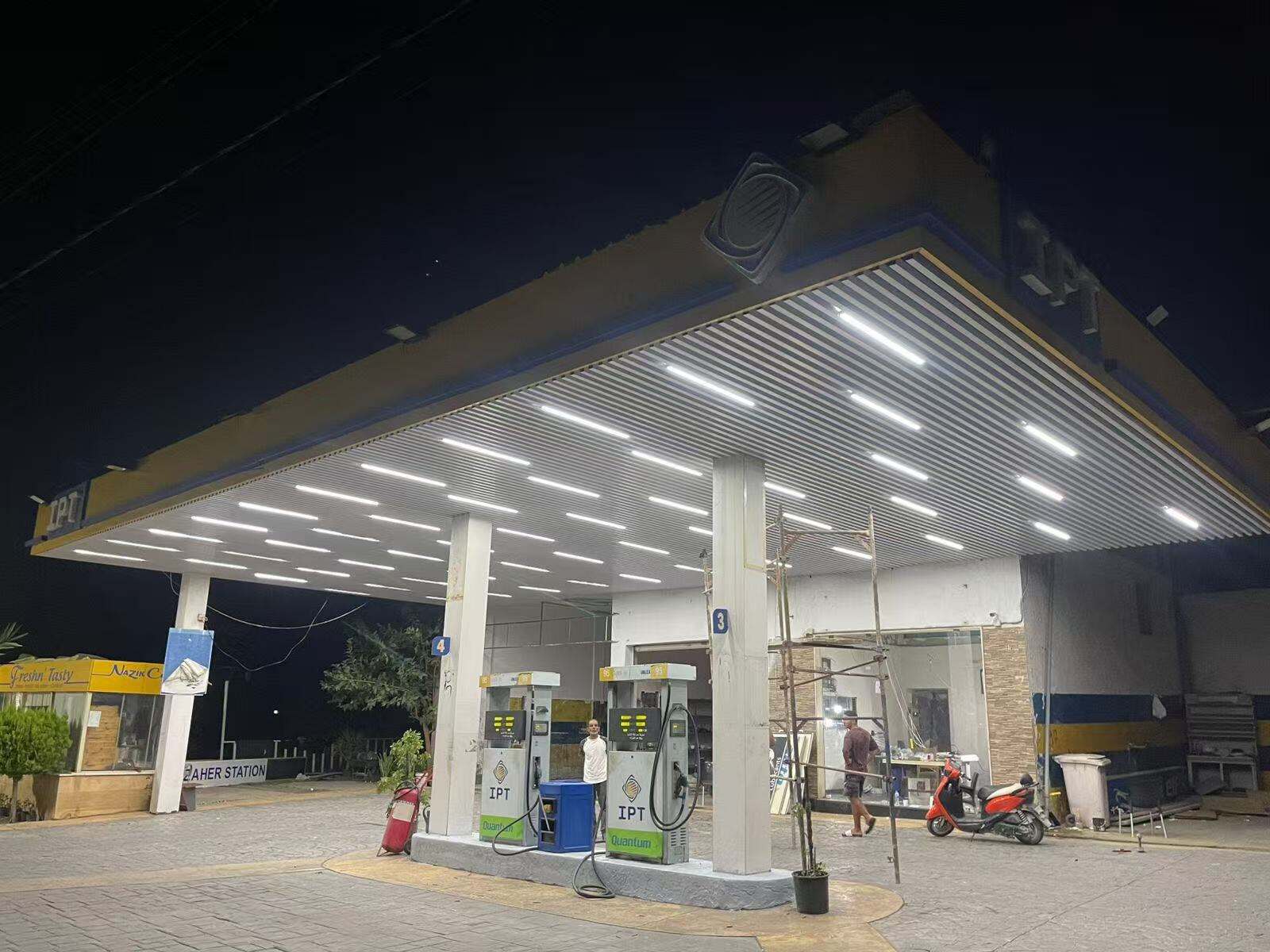
We'll also be upfront about where we fit into this: Guangzhou Dingchengzun Building Materials is a Chinese aluminum ceiling manufacturer with export experience into the Middle East. One reference point we can point to directly is a commercial fuel station renovation project in Lebanon, where the brief was a strip ceiling system able to withstand high temperatures and humidity fluctuations while presenting a professional, modern appearance — environmental stress comparable in kind, though not identical, to UAE coastal conditions.
We don't yet have a long list of completed UAE installations to show you, and we'd rather say that plainly than pad this article with case studies we haven't actually delivered. What we can offer is manufacturing transparency, technical documentation you can hand to your consultant, and a realistic explanation of what to check before you specify any aluminum ceiling product for a Gulf project.
Why Standard Ceiling Materials Struggle in the UAE Climate
Three environmental factors specific to the UAE drive most of the material failures we hear about from contractors and consultants in the region.
1. Coastal humidity and material degradation
Relative humidity in Dubai and Abu Dhabi's coastal developments regularly exceeds 90% during summer months. That moisture finds its way into the ceiling plenum — the void between the structural slab and the finished ceiling — where it accelerates two specific failure modes:
- Mould growth in poorly sealed mineral fibre or untreated gypsum systems
- Sagging and delamination as boards absorb moisture and lose structural rigidity
Aluminum doesn't have this failure mode. It doesn't absorb moisture, so there's nothing for the humidity to act on. This is the single biggest reason aluminum has displaced gypsum and mineral fibre in many UAE commercial specifications over the past decade, particularly in coastal zones and in spaces with mechanical humidity loads (kitchens, spas, pool areas, basements).
2. Dense service zones above the ceiling
UAE commercial buildings tend to be heavily serviced. Chilled water pipework, large-section HVAC ductwork, electrical cable trays, fire suppression lines, and data infrastructure often share the same shallow plenum space. Two practical consequences follow:
- Access matters more than it does in less-serviced markets. A ceiling system that requires destructive removal to service one section becomes a real maintenance cost over a 10-15 year building life.
- Void depth is frequently tight, especially in older building stock or projects with reduced floor-to-floor heights. This affects which ceiling systems are even physically viable before you get to material selection at all.
This is why clip-in and lay-in aluminum systems — which allow individual panels to be removed and replaced without disturbing the surrounding grid — see disproportionate demand in UAE office and retail fit-outs compared to fixed or glued ceiling systems.
3. Long-term finish expectations
UAE tenant and buyer expectations, particularly in Dubai's commercial and hospitality sectors, are benchmarked against global five-star standards. A ceiling that cracks, sags, stains, or visibly ages within two to three years creates a maintenance dispute, not just a cosmetic issue — and in leased commercial space, that often becomes a contractual problem between landlord and tenant.
Aluminum's dimensional stability under heat and humidity cycling is a direct answer to this. Properly manufactured panels with consistent flatness tolerances don't develop the visible waviness that telegraphs through ceiling tiles over time under repeated thermal expansion and contraction — a common visual defect in lower-grade products.
Aluminum vs. Other Ceiling Materials in UAE Conditions
| Factor | Aluminum | Gypsum board | Mineral fibre |
|---|---|---|---|
| Moisture/humidity resistance | High — does not absorb moisture | Moderate — moisture-resistant variants needed in humid zones | Low to moderate — standard tiles can sag in high humidity |
| Corrosion resistance (coastal/salt air) | High with proper alloy and coating | Not applicable (interior use) | Not applicable |
| Fire performance | Non-combustible, supports A2-class assemblies | Fire-rated variants available (Type X/F) | Inherently non-combustible core |
| Maintenance access (clip-in/lay-in) | Excellent — panels removable without damage | Limited — often requires patching after access | Good — standard lay-in grid |
| Typical lifespan in Gulf coastal conditions* | Longest of the three under correct alloy/coating selection | Shorter than aluminum; further reduced in high-humidity zones without moisture treatment | Shortest of the three in humid conditions; prone to sagging |
| Design flexibility (perforation, finish, custom shapes) | High — CNC cutting, multiple finishes | Moderate | Low |
*Relative lifespan ranking reflects general industry consensus on material behavior in humid coastal climates. Specific year ranges vary by product grade, coating quality, and maintenance regime — request manufacturer warranty terms and any third-party durability test data rather than relying on general estimates.
This isn't a case against gypsum or mineral fibre — both remain appropriate and code-compliant choices for many interior applications, and gypsum fire-rated assemblies are mandatory in specific locations regardless of what's used elsewhere in a building. The comparison above is about where aluminum's specific properties solve problems that are disproportionately common in the UAE's climate and building-services context.
Civil Defence Compliance: What a Ceiling System Actually Needs to Satisfy
Fire safety compliance in the UAE is enforced by Dubai Civil Defence (DCD) and the Abu Dhabi Civil Defence Authority, both operating under the UAE Fire and Life Safety Code of Practice. A few points matter specifically for ceiling systems:
Plenum materials must meet combustibility limits. Materials used in ceiling plenum construction are required to be non-combustible, or limited-combustible with a flame spread index no greater than 25 and a maximum smoke-developed index of 50. This applies to the ceiling void as a whole, not just the visible panel.
Fire-rated assemblies are tested as a complete system. In escape corridors, stairwells, and areas above fire-rated partitions, the ceiling assembly — grid, tiles, and any insulation — must be tested and certified together. Substituting a single component (a different tile thickness, a different grid profile) from what was tested can invalidate the rating for the whole assembly. This is a detail that catches out a lot of value-engineering decisions made late in a project.
Fit-out works involving the ceiling typically require DCD drawing approval, particularly where the work intersects with fire alarm or suppression system routing. Approval timelines generally run three to six weeks from submission, so ceiling specification needs to happen early enough in the design program that it doesn't become a critical-path bottleneck.
Non-compliance carries real financial exposure. Under current UAE building safety regulations, penalties for non-compliant fire safety installations can run into the hundreds of thousands of AED for repeat violations, separate from the cost and schedule impact of a failed inspection.
What this means practically for sourcing: ask any ceiling supplier — including us — for the specific fire test classification of the product, and confirm it applies to the exact panel thickness, perforation pattern, and grid combination you intend to install. [Reference the specific standard our products are actually tested against here — e.g. GB, BS 476, EN 13501-1, or another — once confirmed internally. Do not name a standard without verifying it against our actual test reports.] A general claim of "fire resistant" without a specific classification and test report is not sufficient for DCD submission, and any reputable supplier should be able to provide that documentation or be honest that it needs to be tested for your specific configuration.
Matching Ceiling Type to Building Use Case
Different UAE building types create different priority orders between acoustics, hygiene, maintenance access, and aesthetics. Below is how that typically plays out:
Airports, metro stations, and transit halls — Open cell grid ceilings are common here because they combine fire performance with easy access to the dense MEP infrastructure above large public concourses, while still presenting a clean, ordered sightline at scale.
Hospitals and healthcare facilities — Lay-in or clip-in aluminum panels with smooth, non-porous, easily disinfected surfaces are preferred over porous materials, particularly in clinical areas where infection control protocols govern surface selection.
Hotel lobbies and hospitality interiors — Decorative finishes (wood-grain aluminum grille, perforated patterns) let designers achieve a warmer aesthetic without giving up the practical benefits of a metal system in high-humidity zones like spa areas, pool decks, and back-of-house kitchens.
Offices and workplace interiors — Baffle ceilings and linear strip systems are frequently specified for open-plan offices because they offer tunable acoustic absorption alongside easy integration with linear lighting and HVAC diffusers.
Coastal commercial and light-industrial structures — Aluminum veneer and curtain wall-grade panels with corrosion-resistant coatings are the more durable option for exterior-facing or semi-exposed applications where salt air is a long-term degradation factor — the same general coastal-exposure logic behind our Lebanon fuel station project, in a climate with comparable heat and humidity stress to the UAE.
What to Ask Before You Specify (A Practical Checklist)
- What alloy grade is the panel made from, and what is its documented corrosion resistance?
- What fire test standard and classification applies to this exact product configuration — not a general product family?
- What is the plenum-side material composition, and does it meet the non-combustibility/flame-spread requirements for your specific location in the building?
- What is the panel flatness tolerance, and how is it quality-controlled during production?
- Can the system be serviced (panel removal) without damaging adjacent panels or the grid?
- What is the realistic lead time from order confirmation to delivery at a UAE port, including any customs documentation the supplier needs to provide?
Any supplier — manufacturer or distributor — should be able to answer all six without hesitation. If they can't, that's the more useful signal than any marketing claim on a product page.
Where Dingchengzun Fits
We manufacture aluminum ceiling systems (baffle, grid, clip-in, lay-in, and strip ceilings, along with aluminum veneer and curtain wall panels) from our facility in Guangzhou, using AA1100/3003 aluminum alloy and CNC-controlled production with documented flatness tolerances and multi-stage quality inspection.
We're a factory, not a regional distributor, which has two practical implications for a UAE buyer: pricing is closer to production cost than a multi-layer distribution markup, and customization (perforation patterns, custom finishes, non-standard panel sizes) is something we can do in-house rather than sourcing out. The trade-off is that we don't have a regional warehouse in the UAE the way an established local distributor might, so lead time planning matters more. [Production lead time and sea freight transit duration to be confirmed with current logistics data before publishing — do not estimate.] This needs to be built into a project program rather than treated as a same-week local pickup.
If you're evaluating us against a UAE-based or European distributor, the honest comparison points are: cost and customization favor a direct factory relationship; immediate local stock and established regional compliance track record favor an established local supplier. Many project teams use a mix of both depending on the application.
Frequently Asked Questions
Does aluminum ceiling meet Dubai Civil Defence fire requirements? Aluminum itself is non-combustible, but DCD approval depends on the complete tested assembly — panel, grid, and any plenum insulation — meeting the required classification for its location in the building. Always request the specific fire test report for your exact product configuration rather than relying on a general "fire resistant" claim.
Is aluminum ceiling more expensive than gypsum or mineral fibre in the UAE? Upfront material cost is typically higher than standard mineral fibre and comparable to or slightly above fire-rated gypsum. The cost case for aluminum is lifecycle-based: longer service life in humid coastal conditions and lower replacement frequency tend to offset the higher initial spend over a 15–20 year horizon, particularly in high-humidity zones.
What's the difference between clip-in and lay-in aluminum ceiling systems? Lay-in panels rest on an exposed grid and lift out from below for access. Clip-in panels snap into a concealed grid, hiding the grid lines for a cleaner visual finish, but generally require slightly more care to remove for servicing. The choice is largely aesthetic versus maintenance-access preference rather than a performance difference.
How long does it take to import aluminum ceiling panels from a Chinese manufacturer to the UAE? Total lead time depends on production scheduling and the shipping line used from the origin port. [Insert our actual current production lead time and typical sea freight transit duration here once confirmed — these figures should come from logistics/production records, not estimation.] Total lead time should be confirmed directly with the supplier and built into the project program early, since ceiling fit-out is often scheduled late in a build sequence.
Can aluminum ceiling panels be custom-perforated for acoustic performance? Yes. Perforation pattern, hole diameter, and open-area percentage can be adjusted to tune sound absorption for the specific acoustic requirement of a space, and is typically combined with an acoustic fleece backing for additional sound absorption.
Table of Contents
- Why Standard Ceiling Materials Struggle in the UAE Climate
- Aluminum vs. Other Ceiling Materials in UAE Conditions
- Civil Defence Compliance: What a Ceiling System Actually Needs to Satisfy
- Matching Ceiling Type to Building Use Case
- What to Ask Before You Specify (A Practical Checklist)
- Where Dingchengzun Fits
- Frequently Asked Questions