 EN
EN


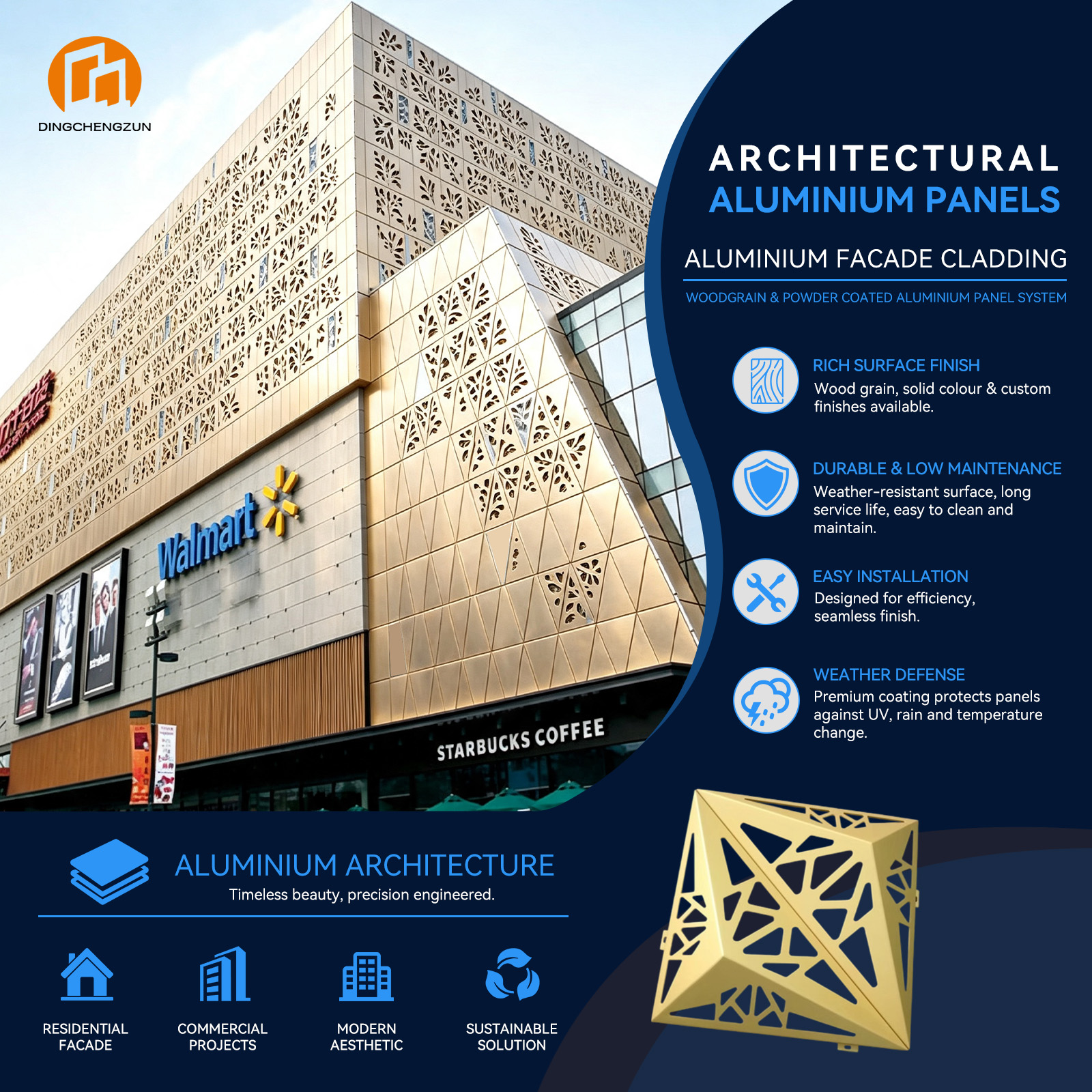
When architects and facade engineers sit down to specify a metal curtain wall system, one decision shapes almost every downstream requirement: solid aluminum panel or aluminum composite panel (ACM)? Both materials show the same bright, flat aluminum face once installed. But underneath that surface, they are fundamentally different products — and that difference cascades through fire code compliance, structural design, long-term maintenance budgets, and total installed cost.
This guide breaks down solid aluminum panels versus ACM panels specifically for curtain wall facade applications, so you can match the right material to your project type, climate, and building code requirements.
What Is a Solid Aluminum Panel?
A solid aluminum panel — sometimes called a pure aluminum panel or aluminum veneer panel — is a single, homogeneous sheet of aluminum alloy with no internal core or bonded layers. Typical curtain wall gauges range from 1.5mm to 6mm, depending on span, wind load, and panel size.
Most solid aluminum curtain wall panels use aluminum alloy 3003, 5005, or similar series, chosen for their balance of strength, corrosion resistance, and formability. Because the material is uniform from face to face, thermal expansion behavior is consistent and predictable — an important factor when engineering joint spacing and attachment systems for large facade runs.
Solid aluminum panels are produced by rolling, stretching, and forming aluminum coil into flat sheets, then finishing with PVDF (fluorocarbon) or powder coatings for color and UV protection.
What Is an Aluminum Composite Panel (ACM)?
ACM (aluminum composite material), also called MCM (metal composite material), consists of two thin aluminum face sheets — typically around 0.020 in. (0.5mm) each — bonded to a continuous core under controlled pressure and temperature. The core is most commonly polyethylene (PE), fire-retardant (FR) mineral-filled polyethylene, or a fully non-combustible A2-rated mineral core.
This sandwich construction gives ACM panels excellent flatness and a favorable stiffness-to-weight ratio, since the core adds rigidity without the mass of solid metal. It's also why ACM has become the dominant choice for cost-sensitive commercial cladding over the past two decades.
Fire Rating & Code Compliance: The Most Consequential Difference
For curtain wall facades on mid-rise and high-rise buildings, fire performance is often the single deciding factor between these two materials.
Solid aluminum panels contain no combustible core. On non-combustible subframes with non-combustible insulation and air barriers, solid aluminum assemblies typically do not require NFPA 285 (or equivalent local) testing for compliance, because there is no bonded layer and nothing inside the panel to burn.
ACM panels with PE or FR cores do contain combustible material, so under the International Building Code (IBC Section 1407) and equivalent codes in other regions, virtually all ACM assemblies on code-regulated buildings require a valid NFPA 285 test report — or the local equivalent multi-story fire propagation test. Critically, that test report is assembly-specific: the tested combination of panel, subframe, insulation, and air barrier must match exactly what is specified. Swapping in a different insulation type or air barrier can void the test data entirely.
A2-rated (mineral core) ACM panels close much of this gap, offering near-non-combustible performance while retaining ACM's lighter weight — but they come at a cost premium over standard PE-core ACM.
Takeaway: For high-rise towers, buildings in jurisdictions with strict facade fire regulations, or projects where NFPA 285 testing paperwork is a procurement bottleneck, solid aluminum panels simplify compliance considerably.
Structural Weight & Engineering Implications
ACM panels weigh significantly less per square meter than solid aluminum panels of comparable visual thickness, because the core replaces solid metal mass with a lighter composite filler. This reduces the load on curtain wall mullions, anchors, and the building's primary structure — a meaningful advantage on large-scale facades or renovation projects where the existing structure has limited additional load capacity.
Solid aluminum panels, being denser, require more robust subframing and can add measurable dead load across a full building elevation. However, that same solidity gives them higher inherent rigidity and resistance to panel oil-canning (visible waviness) without needing the reinforcing ribs that thinner ACM sometimes requires on large panel faces.
Flatness, Finish & Aesthetic Options
Both materials accept a similarly wide range of PVDF and powder-coat finishes — solid colors, metallics, and increasingly, wood-grain and stone-look digital prints.
ACM panels generally have a slight edge in as-manufactured flatness, since the composite core resists the subtle waviness that can appear in large solid aluminum sheets. For projects prioritizing an ultra-flat, mirror-like facade appearance, this is worth factoring in — though on curtain walls using aluminum veneer panels with reinforced backing (such as honeycomb or stiffener systems), solid aluminum can achieve comparable flatness.
Durability & 10-Year Maintenance Cost
This is where solid aluminum panels tend to pull ahead over the life of the building.
Solid aluminum panels conduct heat more efficiently and have no bond line that can fail. There is no delamination risk — the single greatest long-term failure mode reported in aging ACM installations, particularly in high-UV or high-humidity climates where adhesive bond strength degrades over years of thermal cycling. Solid aluminum is also fully recyclable as a single material stream, simplifying end-of-life disposal.
ACM panels with quality PVDF coatings resist fading and chalking well for 15–20+ years, but the composite bond itself is the long-term risk factor. Lower-grade adhesives, poor lamination process control, or repeated freeze-thaw cycling can lead to bubbling or delamination over time — a failure mode that doesn't exist in solid aluminum at all.
For projects where facade replacement or scaffolding access is expensive or logistically difficult (high-rise towers, historic districts, occupied buildings), the lower long-term risk profile of solid aluminum panels often justifies the higher upfront cost.
Cost Comparison: Installed Price Per Square Foot
| Factor | Solid Aluminum Panel | ACM Panel |
|---|---|---|
| Material cost | Higher | Lower |
| Installed weight / structural cost | Higher | Lower |
| Fire testing / compliance cost | Lower (often none required) | Higher (NFPA 285 assembly testing) |
| 10-year maintenance risk | Lower | Moderate (delamination risk) |
| Typical best-fit budget tier | Mid-to-premium | Budget-to-mid |
In raw material terms, ACM is almost always the lower-cost option per square foot. But once fire testing, structural engineering, and long-term maintenance are factored in across the full project lifecycle, the gap narrows — and on high-rise or fire-code-sensitive projects, solid aluminum can be the more economical choice overall once NFPA 285 assembly testing and re-testing costs are included.
Best Applications: When to Choose Which
Choose solid aluminum panels for:
- High-rise and super-tall towers where NFPA 285 compliance is a major cost or schedule risk
- Coastal and typhoon-exposed regions requiring high wind load resistance and long-term structural reliability
- Landmark or flagship architecture where a 20+ year facade lifespan with minimal delamination risk is a priority
- Projects where full material recyclability supports LEED, BREEAM, or EPD sustainability documentation
Choose ACM panels for:
- Low-rise commercial buildings, retail storefronts, and interior applications with lower fire code thresholds
- Budget-driven projects where upfront material cost is the primary constraint
- Facades requiring ultra-flat surfaces or complex curved/formed geometries
- Renovation projects where reducing dead load on existing structure is critical
FAQ
Is ACM panel fireproof? Standard PE-core ACM is not fireproof — it contains a combustible polyethylene core and requires NFPA 285 (or equivalent) testing for use on most code-regulated buildings. A2-rated mineral-core ACM offers near-non-combustible performance and is increasingly required in high-rise applications following stricter post-2017 facade fire regulations in many jurisdictions.
How long do solid aluminum curtain wall panels last? With a quality PVDF coating, solid aluminum curtain wall panels typically perform well for 20–30+ years before recoating or replacement is needed, with minimal risk of the delamination failures that can affect lower-grade composite panels.
Can ACM panels be used on high-rise buildings? Yes, but only with a valid NFPA 285 (or local equivalent) test report for the exact assembly specified, and increasingly only with A2-rated or FR cores rather than standard PE cores, depending on local code requirements.
What is the difference between aluminum veneer panels and ACM panels? Aluminum veneer panels are a form of solid aluminum panel, typically reinforced with a honeycomb or stiffener backing to maintain flatness and rigidity at larger sizes. ACM panels use a bonded composite core instead of a solid metal or honeycomb structure.
Conclusion
Neither material is universally "better" — the right choice depends on building height, local fire code, budget, and how long you need the facade to perform without maintenance intervention. For high-rise, fire-code-sensitive, or long-lifespan projects, solid aluminum veneer panels offer a simpler compliance path and lower long-term risk. For low-rise, budget-conscious, or geometrically complex projects, ACM remains a proven, cost-effective option.
If you're specifying a curtain wall facade and need engineering support on panel thickness, fire rating documentation, or wind load data for your project's climate zone, our team can help match the right aluminum veneer solution to your building requirements.
Table of Contents
- What Is a Solid Aluminum Panel?
- What Is an Aluminum Composite Panel (ACM)?
- Fire Rating & Code Compliance: The Most Consequential Difference
- Structural Weight & Engineering Implications
- Flatness, Finish & Aesthetic Options
- Durability & 10-Year Maintenance Cost
- Cost Comparison: Installed Price Per Square Foot
- Best Applications: When to Choose Which
- FAQ
- Conclusion