 EN
EN


Why Ceiling Material Selection Matters More Than Ever
Ceiling material selection has become an increasingly important part of modern building and interior projects. A ceiling does more than shape the visual appearance of a space. It also affects acoustic comfort, fire performance, moisture resistance, durability, cleanability, and long-term maintenance.
Different spaces place very different demands on ceiling materials and ceiling systems. Offices often need better sound control and easier access for maintenance above the ceiling. Hospitals and clinics require materials that are easier to clean and more suitable for controlled environments. Airports, metro stations, and other public buildings usually need ceiling solutions that can perform reliably in high-traffic conditions over time. Because of these differences, choosing the right ceiling material is no longer only a design decision. It is also a practical decision that affects project performance, operating efficiency, and long-term cost control.
The Changing Role of Modern Ceiling Suppliers
Modern ceiling suppliers are no longer expected to provide standard panels only. In today’s commercial and public building projects, architects, contractors, and procurement teams often need suppliers who can support material selection, system matching, custom fabrication, technical documentation, and project coordination.
This change reflects the growing complexity of ceiling design and installation. Clients are no longer simply buying materials. They are choosing ceiling solutions that must match the function of the space, the design intent, the installation conditions, and the required performance standards. For this reason, modern ceiling suppliers are expected to offer more than product supply. Their value now lies in helping project teams choose the right materials and systems for real project conditions.
What This Article Will Cover
This article explains the best ceiling materials commonly offered by modern ceiling suppliers, including aluminum ceilings, metal ceilings, mineral fiber ceiling tiles, gypsum board ceilings, and PVC or composite ceiling materials. It compares the main advantages and limitations of each option and shows how different materials are used in offices, healthcare spaces, commercial interiors, transportation hubs, and other project environments.
By the end of this guide, readers will have a clearer understanding of which ceiling materials are available, how they differ in performance and application, and how to choose a more suitable ceiling solution for specific project needs.
What Makes a Ceiling Material the “Best” Choice?
The Best Ceiling Material Is Not the Most Expensive One, but the Most Suitable One
The best ceiling material is not always the premium option. In real projects, the right choice depends on how the space will be used, what performance the ceiling system must deliver, and how well the material fits the project budget and installation conditions.
Different environments have different priorities. In open-plan offices, acoustic comfort, maintenance access, and cost efficiency often matter more than a high-end decorative finish. In hospitals and clinics, hygiene, cleanability, and moisture resistance usually become more important. In airports, metro stations, and other high-traffic public buildings, durability, fire-conscious material selection, and long-term maintenance are often key factors. In retail and commercial interiors, visual impact and design flexibility may play a larger role.
For this reason, the best ceiling material should be judged by suitability rather than price alone. A material that performs well in one project may not be the right solution for another. The goal is to choose a ceiling material that balances performance, cost, and installation practicality for the actual conditions of the project.
Key Criteria for Evaluating Ceiling Materials
When comparing ceiling materials, project teams should focus on the criteria that matter most for the intended space.
Appearance and design effect are important because the ceiling strongly influences the overall look of the interior. This is often a higher priority in commercial spaces, showrooms, and public lobbies.
Fire performance should be considered in commercial and public building projects where safety requirements are stricter and material compliance matters.
Acoustic performance is especially important in offices, meeting rooms, classrooms, and other spaces where noise control and speech clarity affect daily use.
Moisture and corrosion resistance are more important in humid environments or in spaces that require stable long-term performance under demanding conditions.
Cleanability and maintenance should be carefully evaluated in hospitals, transport facilities, and other spaces where surfaces must be cleaned regularly and future access above the ceiling may be needed.
Ease of installation affects labor efficiency, project scheduling, and the risk of on-site adjustments.
Service life should be considered as part of long-term value, especially in projects where frequent replacement would increase operating cost.
Cost and overall value should not be judged by purchase price alone. A lower-cost ceiling material may increase total project cost if it requires more maintenance, performs poorly in the actual environment, or leads to shorter replacement cycles.
In practice, the best ceiling material is the one that performs well against the most important criteria for that specific space. This is why material selection should always be based on project needs, not on price or appearance alone.
Common High-Quality Ceiling Materials Offered by Modern Ceiling Suppliers
Modern ceiling suppliers usually offer several ceiling materials for different project needs. The best choice depends on the space, required performance, maintenance needs, and budget.
Aluminum Ceilings
Aluminum ceilings are lightweight, moisture-resistant, corrosion-resistant, and durable. They are widely used in hospitals, airports, metro stations, office buildings, and other public interiors where long-term performance and easier maintenance are important.
Metal Ceilings
Metal ceilings are valued for their modern appearance, clean surface, and easy maintenance. They are often used in commercial lobbies, healthcare spaces, retail interiors, and other high-traffic public areas where hygiene, durability, and visual quality matter.
Mineral Fiber Ceilings
Mineral fiber ceilings are often chosen for their good acoustic performance and cost efficiency. They are commonly used in offices, classrooms, meeting rooms, and similar spaces where sound control is important. However, their suitability should still be checked carefully in areas with higher moisture or stricter cleaning requirements.
Gypsum Board Ceilings
Gypsum board ceilings are known for their moderate cost and flexible design possibilities. They are suitable for standard interior decoration, simple ceiling forms, and spaces that require shaped or customized design details. They are often used in residential, hotel, and general interior projects.
PVC and Composite Ceilings
PVC and composite ceiling materials are often selected because they are easy to install and practical for some standard interior spaces. They can be suitable for projects with basic functional needs, but their application should still be evaluated according to fire performance, durability, and long-term maintenance needs.
Custom-Shaped Ceiling Materials
Custom-shaped ceiling materials are designed for projects that require curved panels, perforated surfaces, irregular forms, or decorative patterns. They are often used in high-end commercial projects, feature spaces, and public buildings where stronger visual identity and custom design are required.
Advantages and Limitations of Different Ceiling Materials
No ceiling material is ideal for every project. The right choice depends on the space, performance requirements, maintenance needs, and budget. Below is a practical comparison of common ceiling materials.
Aluminum Ceilings
Aluminum ceilings are lightweight, moisture-resistant, corrosion-resistant, and durable. They are widely used in hospitals, airports, metro stations, office buildings, and other public interiors where long-term performance and easier maintenance are important. Their main limitation is cost, as aluminum ceiling systems may require a higher initial investment than some basic interior ceiling materials.
Metal Ceilings
Metal ceilings are valued for their modern appearance, clean surface, and easy maintenance. They are often used in hospital corridors, commercial lobbies, retail interiors, and other high-traffic spaces where hygiene, durability, and visual quality matter. However, for projects with simple decorative needs or tighter budgets, metal ceilings may not always be the most economical option.
Mineral Fiber Ceilings
Mineral fiber ceilings are often selected for their good acoustic performance and cost efficiency. They are commonly used in offices, classrooms, meeting rooms, and other spaces where sound control is a priority. Their limitation is that they may be less suitable for areas with higher moisture, stricter cleaning requirements, or more demanding long-term durability needs.
Gypsum Board Ceilings
Gypsum board ceilings are known for their moderate cost and flexible design possibilities. They are suitable for standard interior decoration, shaped ceiling forms, and spaces that require a cleaner decorative finish. However, they may be less practical in areas that need frequent above-ceiling maintenance access or stronger moisture resistance.
PVC and Composite Ceilings
PVC and composite ceilings are often chosen for their convenient installation and practical use in some standard interior spaces. They can be suitable for projects with basic functional needs and controlled indoor conditions. Their limitation is that material selection should still be judged carefully based on fire performance, durability, and long-term maintenance expectations.
How to Choose the Right Ceiling Materials for Different Spaces
The right ceiling material should be selected based on how the space is used. In different environments, priorities such as acoustics, hygiene, durability, maintenance, and design effect are not the same. For this reason, material selection should focus on practical project needs rather than appearance alone.
Office Spaces
Office spaces usually require a clean appearance, good acoustic control, and convenient maintenance access. Mineral fiber ceilings are often used in open-plan offices and meeting rooms because they help improve acoustic comfort. Exposed grid ceiling systems are also practical where frequent access to lighting, air-conditioning, or other services above the ceiling is needed. In reception areas or higher-end office interiors, metal ceilings may also be used to create a cleaner and more modern finish.
Healthcare Spaces
Healthcare spaces place greater emphasis on hygiene, moisture resistance, and cleanability. In hospital corridors, clinics, and treatment areas, metal ceiling systems are often preferred because they are easier to clean and better suited to controlled environments. Ceiling systems with antibacterial surface treatments may also be considered where stricter hygiene requirements apply. However, the final choice should still depend on the specific area, since maintenance access and environmental conditions may vary within the same healthcare project.
Commercial Spaces
Commercial interiors often focus more on visual impact, design quality, and brand image. In shopping malls, retail stores, showrooms, and commercial lobbies, open cell ceilings, baffle ceilings, and custom-shaped metal ceiling materials are commonly used to create stronger architectural character and a more memorable interior effect. For projects with tighter budgets or simpler design goals, more standard ceiling materials may still be suitable if they support the intended visual style.
Transportation Hubs
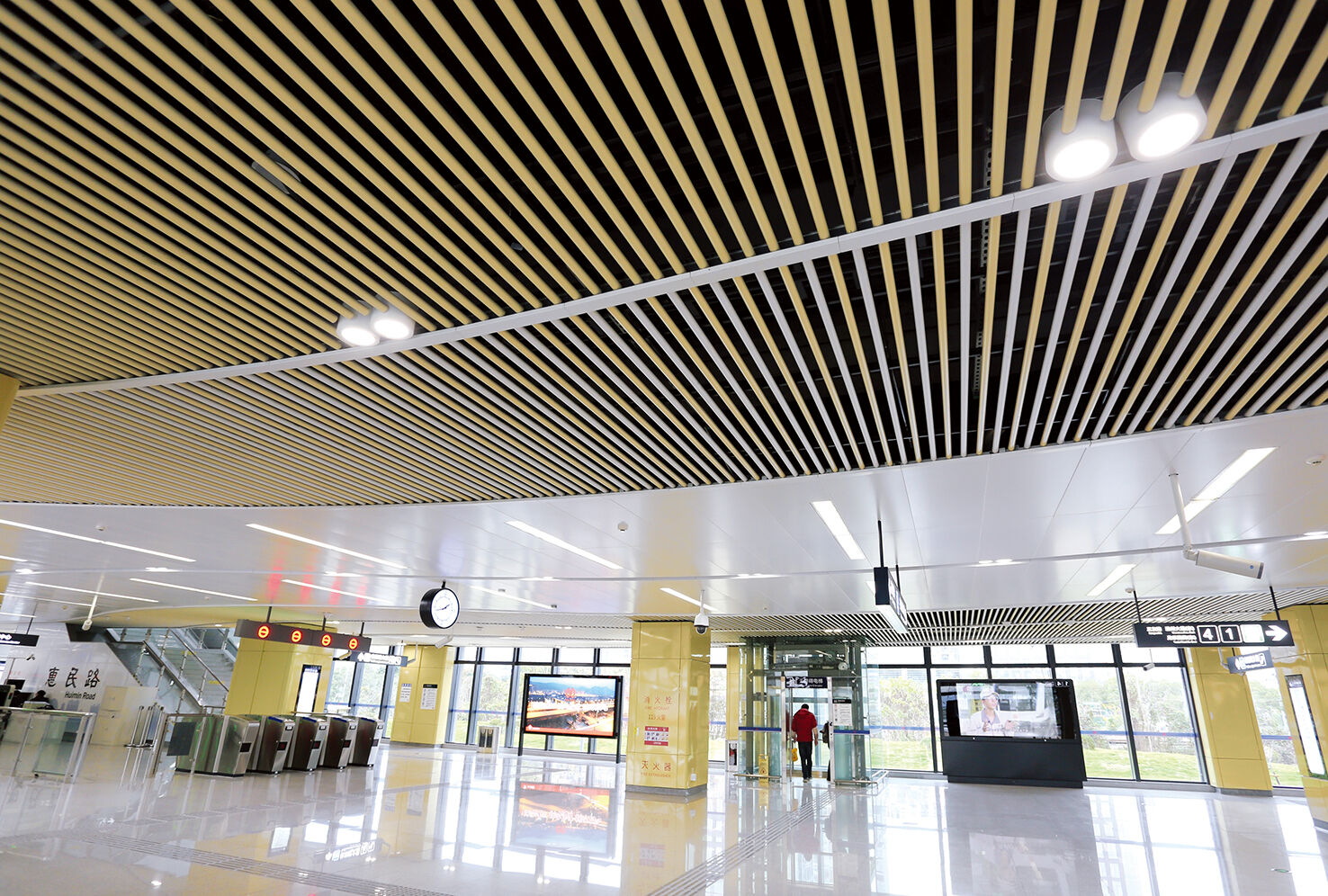
Transportation hubs such as airports, metro stations, terminals, and transit corridors usually require ceiling materials with strong durability, good fire performance, and convenient maintenance. Aluminum ceilings, strip ceilings, baffle ceilings, and aluminum veneer materials are widely used because they perform well in high-traffic public environments and support long-term use. In these projects, maintenance efficiency and reliability are often just as important as appearance.
Educational Spaces
Educational spaces usually need a balance of acoustic performance, practicality, and cost efficiency. In classrooms, lecture halls, libraries, and training rooms, mineral fiber ceilings are often chosen because they help reduce noise and improve everyday comfort. Metal acoustic ceiling systems can also be considered when easier cleaning, stronger durability, or longer service life is required.
Residential and Standard Interior Spaces
Residential and standard interior spaces often place more emphasis on cost control and decorative effect. Gypsum board ceilings are widely used because they offer flexible design possibilities and a moderate cost. PVC and other basic ceiling materials may also be suitable for some ordinary interior applications where installation convenience is important. However, the final choice should still consider long-term maintenance, durability, and the actual conditions of the space.
What Else Can Modern Ceiling Suppliers Provide Beyond Materials?
Modern ceiling suppliers do more than supply ceiling panels. In commercial and public building projects, their value often depends on how well they support material selection, system coordination, custom production, and project delivery.
Material Selection Advice
Professional suppliers can recommend suitable ceiling materials based on the project type, design goals, performance requirements, and budget. This helps project teams avoid unsuitable choices early, especially in offices, hospitals, retail interiors, and transport spaces where material priorities are different.
Complete Ceiling System Support
A ceiling project usually requires more than the visible panel. Suppliers can provide matching suspension systems, trims, hangers, carriers, and other accessories to ensure proper system compatibility. This is important because poor system matching can lead to uneven joints, installation delays, and more rework on site.
Custom Fabrication Services
Many projects require more than standard products. Modern ceiling suppliers often support custom sizes, finishes, perforation patterns, curved panels, and other non-standard details. This is especially useful in airports, shopping malls, feature spaces, and other projects where ceiling design must match specific architectural conditions.
Samples and Mock-Up Support
Material samples, finish samples, and mock-ups help architects, contractors, and buyers confirm appearance, color, and system details before production begins. This step is particularly important in commercial interiors and design-driven projects where finish consistency matters.
Technical Documents and Drawing Support
Reliable suppliers should be able to provide product specifications, installation instructions, test reports, detail drawings, and shop drawings. These documents help reduce communication errors and make it easier for project teams to coordinate design, procurement, and installation.
Production, Delivery, and After-Sales Service
Modern ceiling suppliers also support production scheduling, quality control, packaging, shipment coordination, and after-sales service. In large or export projects, stable delivery and fast follow-up support can help reduce delays, material shortages, and installation problems.
Common Mistakes When Choosing Ceiling Materials
Choosing ceiling materials is not only about price or appearance. In many projects, problems happen because important technical and practical factors are ignored too early. Below are some of the most common mistakes in ceiling material selection.
Focusing Only on Price Instead of the Application
A lower price does not always mean better value. Different spaces have very different requirements for acoustics, hygiene, durability, moisture resistance, and maintenance. A material that works well in a standard interior may not be suitable for a hospital corridor, an airport terminal, or a high-traffic commercial space. If the application is ignored, the project may face higher maintenance costs or earlier replacement later.
Looking Only at the Panel Instead of the Full Ceiling System
A ceiling is not only the visible panel. Suspension systems, trims, hangers, and other accessories also affect installation quality, alignment, maintenance access, and the final appearance. If system compatibility is not considered early, the project may face uneven joints, installation delays, or more rework on site.
Paying Attention Only to Appearance Instead of Performance
A ceiling may look attractive, but visual effect alone is not enough. Fire performance, acoustic performance, moisture resistance, and cleanability should also be checked carefully. In offices, hospitals, schools, and transport facilities, performance often matters just as much as appearance, and sometimes even more.
Ignoring Future Maintenance and Cleaning Needs
Some ceiling materials look suitable at first, but become less practical when regular cleaning, inspection, or replacement is needed. This is especially important in healthcare spaces, offices, transport facilities, and other active environments. If maintenance access and cleaning needs are not considered from the beginning, long-term operating costs may increase.
Failing to Confirm Custom Parameters and Site Conditions Early
For custom ceiling projects, dimensions, finishes, perforation patterns, openings, edge details, and site conditions should be confirmed before production starts. It is also important to check installation requirements and transport limits in advance. If these details are not confirmed early, the project may face production errors, delays, or installation problems later.
How to Choose a Reliable Modern Ceiling Supplier
Choosing a reliable ceiling supplier is not only about comparing prices. In commercial and public building projects, the supplier’s product range, customization capability, technical support, delivery reliability, and after-sales response can all affect project quality, installation efficiency, and long-term maintenance.
Product Range
A reliable supplier should offer a complete range of ceiling materials and ceiling systems. This is important because different spaces within the same project may require different solutions. If the product line is too limited, project teams may need to source from multiple suppliers, which can increase coordination problems and make system matching more difficult.
Customization Capability
Many projects require more than standard products. A dependable supplier should be able to support custom sizes, finishes, perforation patterns, curved panels, and other non-standard requirements. This is especially important in airports, shopping malls, hospitals, and feature spaces where ceiling systems must fit specific design and installation conditions.
Project Experience
Suppliers with experience in offices, hospitals, schools, shopping centers, airports, or transport facilities usually understand application needs more clearly. They are often more familiar with issues such as maintenance access, hygiene standards, acoustic requirements, and large-area coordination. Strong project experience can help reduce avoidable mistakes during selection and installation.
Technical Documents and Test Reports
A professional supplier should be able to provide product specifications, installation instructions, detail drawings, and relevant test reports. These documents help architects, contractors, and buyers confirm ceiling system suitability before production and installation. Without clear technical support, communication errors and site problems are more likely to happen.
Delivery and After-Sales Stability
Stable delivery and reliable after-sales service are also essential. A good supplier should be able to support production scheduling, packaging, shipment coordination, and fast follow-up when problems occur. In large or time-sensitive projects, unstable delivery or slow after-sales response can lead to delays, shortages, and extra installation costs.
Table of Contents
- Why Ceiling Material Selection Matters More Than Ever
- What Makes a Ceiling Material the “Best” Choice?
- Common High-Quality Ceiling Materials Offered by Modern Ceiling Suppliers
- Advantages and Limitations of Different Ceiling Materials
- How to Choose the Right Ceiling Materials for Different Spaces
- What Else Can Modern Ceiling Suppliers Provide Beyond Materials?
- Common Mistakes When Choosing Ceiling Materials
- How to Choose a Reliable Modern Ceiling Supplier